
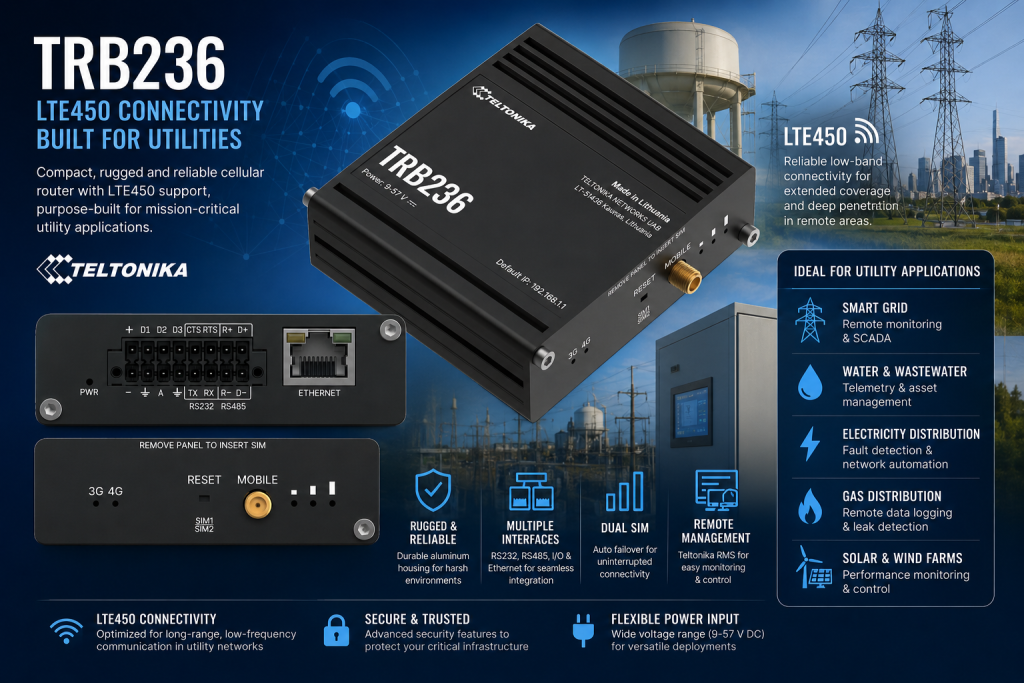
The launch of the Teltonika TRB236 is another sign that industrial connectivity is moving in a very different direction from mainstream consumer mobile broadband.
For years, the telecoms industry focused heavily on speed. Faster 4G. Faster 5G. Higher bandwidth. More streaming. More devices. But utility companies, SCADA operators, energy providers and infrastructure organisations often care far more about reliability, propagation, resilience and control than raw download speed.
That is exactly where LTE 450 fits.
The Teltonika TRB236 is designed specifically for industrial and utility-grade communications where long-range coverage, deep penetration and stable telemetry matter more than headline broadband performance. Rather than targeting office internet access or retail connectivity, this gateway is aimed squarely at critical infrastructure.
In many ways, the TRB236 reflects the wider return of private cellular networking and utility-owned communications infrastructure.
What Is the Teltonika TRB236?
The TRB236 is an industrial LTE 450 gateway built by Teltonika Networks for utility, SCADA, telemetry and industrial IoT environments.
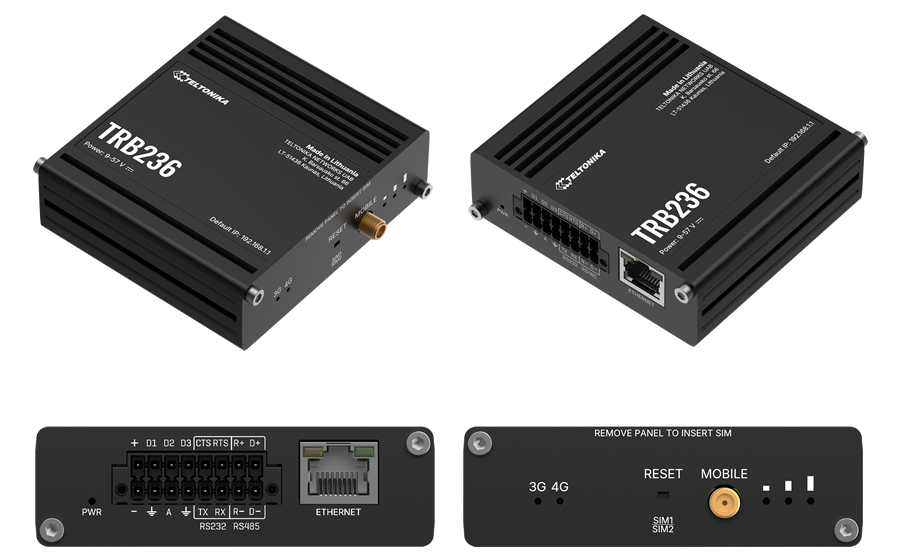
Unlike a standard office router, the TRB236 is built for deployment inside:
- Electrical substations
- Utility cabinets
- Smart grid infrastructure
- Water pumping stations
- Renewable energy sites
- Industrial control cabinets
- SCADA telemetry systems
- Rail and roadside infrastructure
The unit combines LTE 450 connectivity with industrial interfaces such as:
- RS232
- RS485
- Ethernet
- Digital I/O
- VPN support
- Modbus integration
- MQTT support
- RMS remote management
This allows the TRB236 to bridge older operational technology systems with modern IP-based infrastructure.
Why LTE 450 Is Different
Most public mobile networks operate on higher frequency bands such as:
- 800 MHz
- 900 MHz
- 1800 MHz
- 2100 MHz
- 2600 MHz
LTE 450 operates far lower.
That changes the physics dramatically.
Lower frequencies travel further and penetrate difficult environments more effectively. This is why LTE 450 has become increasingly attractive for utility operators and critical infrastructure providers.
Compared with higher LTE bands, LTE 450 can provide:
- Better rural coverage
- Fewer dead zones
- Improved building penetration
- Better underground propagation
- More reliable connectivity in difficult terrain
- Wider coverage from fewer cell sites
For utility organisations operating remote infrastructure across huge geographic areas, that is extremely valuable.
You can learn more about the technology itself here:
Why Utility Companies Are Investing in LTE 450
One of the biggest shifts happening globally is the move toward private utility-owned LTE infrastructure.
Traditional public mobile networks are designed primarily for consumers. Utility providers have very different requirements:
- Long lifecycle support
- Infrastructure resilience
- Secure telemetry
- Controlled network access
- Predictable latency
- SCADA reliability
- Coverage in remote environments
- Independence from public mobile congestion
This is why many energy and infrastructure providers are now building or evaluating private LTE networks using 450 MHz spectrum.
The TRB236 is clearly designed to fit directly into this environment.
Key Features of the TRB236
| Feature | Benefit |
|---|---|
| LTE 450 support | Long-range and deep penetration connectivity |
| Industrial interfaces | Connects directly to legacy SCADA and telemetry systems |
| RS232 and RS485 | Supports industrial serial communications |
| Compact DIN-rail design | Easy cabinet installation |
| VPN support | Secure remote connectivity |
| Dual SIM/eSIM support | Flexible operator management |
| RMS compatibility | Centralised fleet monitoring |
| RutOS platform | Industrial-grade Linux-based operating system |
| Digital I/O | Alarm and automation integration |
| Low power operation | Suitable for remote infrastructure |
TRB236 vs Standard Industrial 4G Routers
A lot of people initially assume the TRB236 is simply another industrial LTE router.
It is not.
The difference is the deployment philosophy.
Standard industrial 4G routers are often used for:
- Temporary internet access
- CCTV broadband
- Retail failover
- General remote networking
The TRB236 is built more for:
- Utility telemetry
- SCADA
- Grid monitoring
- Industrial automation
- Private LTE infrastructure
- Critical communications
The emphasis shifts from bandwidth toward resilience and operational stability.
Example Use Cases
Smart Grid Monitoring
Modern electrical grids increasingly rely on distributed monitoring systems.
Substations, transformers and switching equipment constantly report operational data back to control systems.
The TRB236 can provide secure long-range connectivity for:
- Voltage monitoring
- Fault reporting
- Remote diagnostics
- Power quality monitoring
- Grid balancing systems
Because LTE 450 propagates so effectively across rural environments, it becomes particularly useful for dispersed infrastructure.
Renewable Energy Sites
Wind farms and solar installations are often deployed in remote locations where traditional broadband is unavailable or unreliable.
The TRB236 allows operators to securely connect:
- Turbine telemetry
- Environmental sensors
- Inverter monitoring systems
- CCTV systems
- Maintenance alerts
- Remote access systems
This becomes increasingly important as renewable infrastructure expands further into rural and coastal areas.
Water Industry Telemetry
Water companies operate thousands of remote assets including:
- Pumping stations
- Reservoirs
- Treatment plants
- Flood monitoring systems
- Pressure monitoring stations
These locations are frequently difficult for standard LTE coverage.
LTE 450 can dramatically improve connectivity reliability in these environments.
Typical TRB236 deployments may include:
- Remote tank level monitoring
- Pump alarms
- Telemetry backhaul
- Valve control systems
- Environmental monitoring
SCADA and Industrial Automation
Many industrial sites still rely heavily on legacy serial communications.
That is why RS232 and RS485 support remain so important.
The TRB236 allows organisations to modernise connectivity without replacing entire SCADA infrastructures.
This can significantly reduce upgrade costs while extending operational life.
Railway and Transport Infrastructure
Rail operators increasingly require resilient connectivity for:
- Signalling systems
- Environmental monitoring
- Remote diagnostics
- CCTV systems
- Passenger information systems
- Roadside infrastructure
Lower frequency LTE bands often perform significantly better in cuttings, tunnels and rural rail environments.
LTE 450 vs Traditional Public Mobile Networks
| Feature | LTE 450 | Standard Public LTE |
|---|---|---|
| Coverage range | Very long | Moderate |
| Building penetration | Excellent | Moderate |
| Rural performance | Strong | Variable |
| Underground propagation | Better | Often weak |
| Infrastructure ownership | Often private | Public operator |
| Congestion risk | Lower | Higher |
| Utility suitability | Excellent | Moderate |
| SCADA optimisation | Strong | Limited |
| Critical infrastructure focus | High | Low |
UK Networks and MVNO Support
Although LTE 450 deployment in the UK is still developing compared with some European markets, the broader industrial IoT ecosystem around the TRB236 remains highly relevant.
The gateway can support hybrid connectivity strategies combining:
- Private LTE 450
- Public LTE fallback
- Multi-network roaming
- IoT SIM deployments
- Private APNs
- VPN-secured access
This is increasingly important because critical infrastructure operators rarely want dependency on a single network.
UK Operators Relevant to Industrial Deployments
The wider industrial IoT ecosystem around the TRB236 may involve connectivity from:
- EE
- Vodafone
- O2
- Three
Alongside specialist IoT and MVNO providers offering:
- Roaming SIMs
- Fixed private IP services
- Multi-network SIMs
- eSIM provisioning
- Private APN connectivity
You can read more about industrial IoT SIM strategies here:
Antenna Considerations for LTE 450
One of the biggest mistakes in industrial cellular deployments is focusing entirely on the gateway while ignoring RF design.
In reality, antennas often determine whether a deployment succeeds or fails.
This becomes even more important at 450 MHz.
Why 450 MHz Antennas Matter
450 MHz wavelengths are physically larger than standard LTE frequencies.
That means:
- Antenna design matters more
- Placement becomes critical
- Cable losses behave differently
- Ground plane performance matters
- Cheap wideband antennas may perform poorly
Many successful LTE 450 deployments use:
- Dedicated 450 MHz antennas
- Ruggedised omnidirectional antennas
- Directional Yagi antennas
- Mast-mounted antennas
- Low-loss coaxial cable
Typical LTE 450 Antenna Deployment Locations
Industrial LTE 450 antennas are often mounted:
- On substations
- On utility poles
- On rooftops
- On external cabinets
- On telemetry masts
- On renewable infrastructure
This helps maximise the propagation benefits of the lower frequency spectrum.
Underground and Difficult Environments
One of LTE 450’s major strengths is improved penetration into difficult environments.
However, reinforced concrete and metal enclosures can still create major attenuation.
In these cases, external antennas become essential.
Typical problem environments include:
- Basement utility rooms
- Underground pumping stations
- Concrete switchgear rooms
- Metal cabinets
- Industrial compounds
Proper antenna positioning can transform connectivity reliability.
Learn more here:
Security and Critical Infrastructure
Security concerns are one of the biggest drivers behind private LTE adoption.
Industrial infrastructure operators increasingly worry about:
- Internet-facing routers
- Public IP exposure
- Remote exploitation
- Critical infrastructure attacks
- Unsecured SCADA systems
- Legacy operational technology
The TRB236 supports modern VPN technologies including:
- OpenVPN
- IPsec
- WireGuard
- GRE tunnelling
This allows organisations to isolate and secure infrastructure properly.
The wider movement away from exposed public cellular infrastructure is accelerating globally.
RMS Remote Management
Like other industrial Teltonika products, the TRB236 supports RMS (Remote Management System).
This enables operators to:
- Monitor remote devices
- Deploy firmware updates
- Diagnose connectivity problems
- Restart infrastructure remotely
- Track device health
- Manage large deployments centrally
For organisations managing hundreds or thousands of remote assets, remote management becomes operationally essential.
TRB236 Compared with Traditional Utility Connectivity
| Technology | Strengths | Weaknesses |
|---|---|---|
| Fibre | High bandwidth | Expensive rural deployment |
| Public LTE | Widely available | Congestion and coverage issues |
| Satellite | Remote coverage | Higher latency |
| Licensed radio | Reliable | Limited scalability |
| LTE 450 | Long range, resilient | Smaller ecosystem |
| Copper PSTN | Legacy support | Being phased out |
Frequently Asked Questions
What is LTE 450 mainly used for?
LTE 450 is primarily used for utility networks, SCADA systems, smart grids, industrial telemetry and critical infrastructure communications.
Is the TRB236 a normal broadband router?
No. The TRB236 is an industrial gateway designed for telemetry and infrastructure applications rather than consumer internet access.
Why do utility companies like 450 MHz?
Lower frequencies travel further and penetrate difficult environments more effectively, making them ideal for remote infrastructure and underground installations.
Does the TRB236 support VPNs?
Yes. It supports multiple industrial VPN technologies including OpenVPN, IPsec and WireGuard.
Can the TRB236 work with UK mobile networks?
Yes. Hybrid deployments can combine LTE 450 with mainstream UK LTE operators and IoT SIM providers.
Why are external antennas important?
Antennas dramatically affect industrial cellular performance. Proper antenna design and placement often determine deployment success.
Does LTE 450 replace 5G?
Not really. LTE 450 serves a different role focused on resilience, propagation and infrastructure reliability rather than ultra-high consumer bandwidth.
Final Thoughts
The Teltonika TRB236 is part of a much bigger shift happening across industrial communications.
For years, connectivity discussions revolved almost entirely around consumer broadband speeds. But utility operators, infrastructure providers and industrial organisations are increasingly prioritising:
- Reliability
- Resilience
- Coverage
- Security
- Control
- Long lifecycle support
LTE 450 addresses many of those requirements extremely well.
The TRB236 is not designed to compete with office broadband routers or high-speed consumer 5G hardware. It is designed for infrastructure that simply has to keep working.
And in the industrial world, that matters far more than flashy speed test screenshots.
Further Reading
- LTE450 Home
- What Is LTE450?
- Private LTE Networks
- Utility Communications
- Industrial Antennas
- Coverage Planning
- IoT Connectivity