
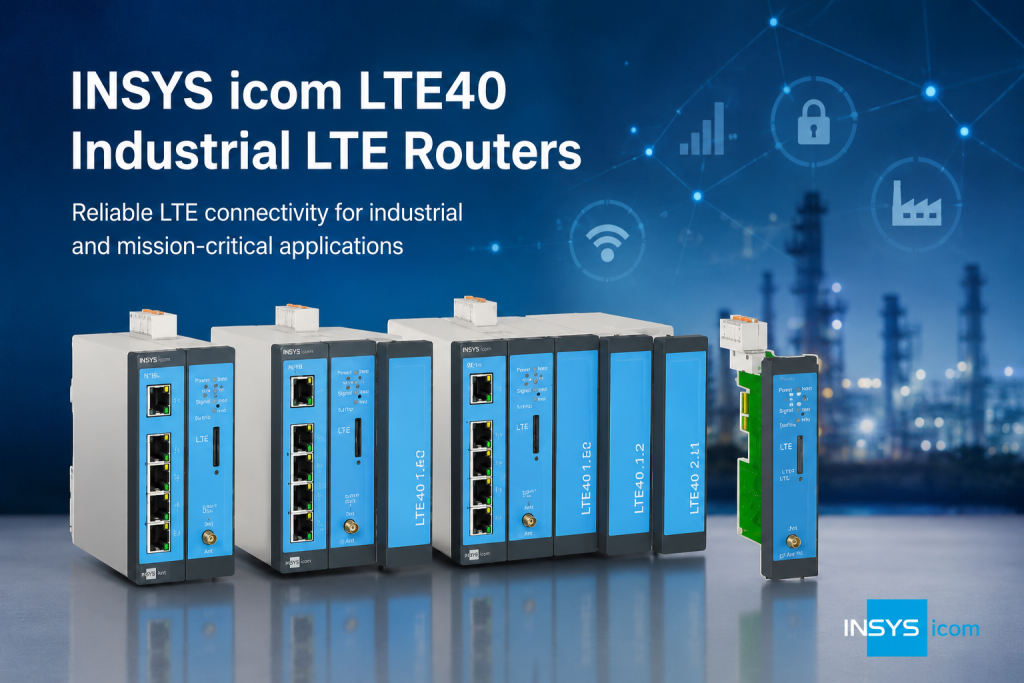
There are not many manufacturers who have spent over three decades focused on industrial data communication and ended up being one of the first three router vendors approved on the 450connect whitelist. INSYS icom is one of them. Based in Regensburg, Germany, and founded in 1992, the company has built a reputation that is difficult to dismiss – especially if you work in energy, water, or any sector that cannot afford to lose its comms link at the wrong moment.
This post covers who INSYS icom are, what they build for the LTE450 market, why the 450 MHz band exists and where it is headed, and which applications make the most sense. Where relevant, I have linked out to deeper technical content on this site and on related Peter Green reference sites covering eSIM and eUICC, SGP.32 for IoT, and IoT SIM provisioning via IoTMail.
Who is INSYS icom?
INSYS icom GmbH is headquartered at Hermann-Kohl-Str. 22, 93049 Regensburg, Germany. The company started life in 1992 as a small startup – INSYS Microelectronics – and has since grown into what it describes as a market leader in the energy and water supply segments of industrial networking.
The product range spans industrial routers, VPN-managed services, device management platforms, and edge computing modules. Everything is designed and manufactured in Germany. That is not just a badge – it matters to procurement teams in KRITIS environments where supply chain provenance is a compliance concern.
Their self-described positioning is “simple, reliable, secure, open.” In practice this translates to DIN-rail-mountable hardware, a hardened Linux-based operating system, encrypted VPN tunnels, integration with SCADA, ERP and cloud platforms, and a modular architecture that lets operators extend connectivity options without swapping out the base unit.
INSYS icom serves mechanical engineering, energy, renewables, water and wastewater, and building technology. In the renewable energy space – wind farms and solar parks specifically – they claim market leadership for router connectivity.
Since early 2025, INSYS icom has also been a member of the Versorger-Allianz 450, an association of more than 200 energy and water utilities that co-owns 450connect and is driving the 450 MHz network build-out. That membership gives them a seat at the table when network policy and device certification decisions are made.
What is LTE450 and Why Does It Exist?
LTE450 is 4G LTE operating in the 450 MHz frequency band – specifically LTE Bands 31 and 72. In Germany and Austria, Band 72 is in use (uplink 451-456 MHz, downlink 461-466 MHz). Band 31 covers uplink 452.5-457.5 MHz and downlink 462.5-467.5 MHz and is used in several other countries.
The physics are the reason this band was worth fighting for. Sub-GHz radio waves travel further and penetrate obstacles more effectively than the frequencies used by standard commercial LTE, which sits in the 700 MHz to 2.6 GHz range. A commercial LTE network covering a country the size of Germany might require tens of thousands of base stations. An LTE450 network achieving equivalent geographic coverage needs only a few thousand. That is not a minor efficiency gain – it fundamentally changes the economics and resilience profile of the network.
For operators of critical infrastructure, three properties stand out:
Reach. The 450 MHz signal gets into basements, shafts, underground installations, and rural locations that standard LTE cannot reliably serve. Water pumping stations, transformer substations, and unmanned remote generation assets are often in exactly these locations.
Resilience. The 450connect network in Germany is designed for availability during extended power failure scenarios. Base stations are backed by emergency power supplies. Siting decisions account for flood risk. Network planning limits congestion per radio cell, with application-level prioritisation reserved for critical traffic. In Europe, communications networks serving critical infrastructure are required by mandate to remain operational for a minimum of 24 hours in the event of a power failure – well beyond what most commercial cellular networks can guarantee.
Exclusivity. This is not a public network. Access is restricted to operators of critical infrastructure. SIM cards are issued only by the licensed network operator – in Germany that is 450connect, in Austria it is ArgoNET. The constrained subscriber base means no contention with consumers streaming video during an incident.
The technology itself is standardised. 3GPP Release 16 formalised the 450 MHz band for LPWA LTE communication, covering standard LTE, LTE-M, and NB-IoT. This matters for investment confidence – LTE450 is not a proprietary sidetrack, it is a ratified global standard with a long-term roadmap.
For a fuller treatment of how eSIM and eUICC provisioning applies to managed LTE450 deployments, see the euicc.co.uk wiki and the SGP.32 reference at sgp32.co.uk – the remote SIM provisioning standards are directly relevant to large-scale critical infrastructure rollouts where physical SIM swap is impractical.
The Network State: Germany and Beyond
Germany – 450connect
450connect GmbH was awarded the 450 MHz spectrum licence by the Federal Network Agency (Bundesnetzagentur) in March 2021, with rights running to 2040. Nokia was brought in as the network infrastructure partner on a contract covering supply, deployment, and 20-year lifecycle management of the network.
Coverage growth has been rapid. From around 30% geographic coverage in Q1 2025, 450connect passed 90% coverage by December 2025. Full nationwide coverage is planned for 2026. More than 10,000 transformer stations are already connected to the network.
The whitelist of approved devices – which INSYS icom joined in early 2025 – has expanded steadily. Approved router manufacturers now include Garderos, INSYS icom (MRX LTE450), Welotec, Advantech, AddSecure, and MC Technologies. 450connect has accelerated the certification process in response to market demand.
Austria – ArgoNET
ArgoNET is the Austrian equivalent of 450connect, operating a 450 MHz network for Austrian critical infrastructure operators. Coverage is available across significant parts of the country and expansion is ongoing.
Wider Europe
Germany and Austria are the most mature LTE450 markets in terms of dedicated KRITIS networks. Elsewhere in Europe, Sweden and Finland are active in licensing 450 MHz for energy and public safety use. Denmark’s Cibicom operates a mission-critical 450 MHz LTE network for essential services suppliers, also built on Nokia infrastructure. The 450 MHz Alliance, a global industry body, continues to attract new members – Tait Communications, Hytera, Crosscall, and others joined during 2025.
The pattern is consistent: regulators recognise that commercial mobile networks were not designed with the resilience characteristics that critical infrastructure demands, and sub-GHz spectrum is the practical answer.
Why 4G and Not 5G?
The FAQ on the INSYS icom site addresses this directly, and it is worth repeating. 5G is optimised for high data rates and ultra-low latency – neither of which is a primary requirement for SCADA telemetry, smart meter gateways, or substation monitoring. LTE is well understood, proven in field deployments across Europe, and carries no integration risk for existing SCADA and OT systems. The 450connect licence also runs to 2040, giving operators a minimum 15-year investment horizon on hardware deployed today.
The INSYS icom LTE450 Product Range
INSYS icom’s LTE450 offering is built around the modular MRX router platform, with a plug-in card expansion option that allows existing MRX installations to adopt LTE450 without replacing the base unit.
MRX3 LTE450
A three-slot modular DIN-rail router with LTE450 connectivity built in alongside standard LTE and dual SIM support. The three card slots allow additional interfaces to be added – DSL, fibre, additional LAN ports, RS-232, RS-485 – depending on the installation requirement. Intelligent fallback ensures automatic switchover if the primary connection drops.
The dual SIM approach is particularly practical at this stage of the 450connect rollout. An operator can run LTE450 as the primary connection where coverage exists and fall back to a standard LTE SIM on a commercial network for locations not yet covered, or for high-bandwidth tasks where LTE450 data costs make standard LTE the better economic choice.
MRX5 LTE450
The five-slot variant of the MRX platform, intended for installations requiring more interface diversity or higher levels of redundancy. Same core LTE450 and dual SIM capability, with two additional plug-in card slots for combining connection types – LTE450, standard LTE, DSL, and fibre can coexist in a single unit. This is the right choice for substations or distribution network nodes where multiple communication paths are needed and a single point of failure is unacceptable.
MRcard PL450
The MRcard PL450 is an expansion card for existing MRX series routers. If an operator already has MRX hardware in the field – possibly deployed years ago for standard LTE or DSL connectivity – the PL450 card adds LTE450 capability without replacing the host unit. This significantly lowers the cost of LTE450 adoption for operators with established MRX fleets.
The card supports Band 72 (and Band 31) and handles the 450 MHz link while the host router manages all the wider connectivity management, VPN, and security functions it was already performing.
icom Connectivity Suite – VPN
The iCS VPN is INSYS icom’s managed VPN service, providing remote access and secure site-to-site networking for machines and installations connected via MRX hardware. It sits above the physical connectivity layer – whether that connectivity is LTE450, standard LTE, DSL, or fibre. For CRITIS environments, this is the layer that enforces encryption, access control, and audit logging for remote SCADA sessions and maintenance connections.
icom Router Management (iRM)
The iRM platform handles firmware rollouts, configuration management, security certificate deployment, and logging across fleets of deployed MRX devices. For operators managing hundreds or thousands of remote sites – transformer substations, pumping stations, generation assets – centralised device management is not optional. iRM provides it within the INSYS icom ecosystem.
Applications
The use cases for LTE450 split broadly into primary connectivity and failover connectivity. INSYS icom’s modular approach covers both.
Smart grid and substation automation. Transformer stations, distribution substations, and switching equipment need reliable, low-latency communication links for protection signalling, SCADA telemetry, and fault management. LTE450 provides the reach to unmanned rural substations that DSL and fibre may not serve, and the resilience that commercial LTE cannot guarantee.
Smart metering. Meter gateways for electricity, gas, and water need a communication path that works in basement installations and meter cupboards with limited signal penetration. The 450 MHz signal characteristics address this directly. In Germany, legislation is making remote metering and control of distribution network elements mandatory, with millions of connection points in scope.
Renewable energy connectivity. Wind turbines and solar parks are often in rural or coastal locations with limited fixed-line infrastructure. INSYS icom claims market leadership in this sector, and the combination of LTE450 for primary coverage and standard LTE as fallback maps well onto the connectivity challenges of dispersed generation assets.
Water and wastewater. Pumping stations, treatment works, and reservoir monitoring installations are frequently remote and sometimes underground. LTE450 coverage at these locations makes SCADA monitoring and remote control viable where other technologies fail.
DSL/fibre failover. Cable cuts from excavation work are a common cause of outages at distribution network sites. An LTE450 router running as an automatic failover ensures that SCADA and control systems maintain connectivity regardless of landline status. The switchover is automatic – the site does not go dark while someone dispatches an engineer.
Emergency and crisis communications. The 450connect network is explicitly designed to remain operational during blackout scenarios, with backed-up base stations and flood-resilient siting. For civil protection, emergency services coordination, and grid restoration management, a network that stays up when the commercial networks degrade has obvious value.
Antenna Considerations
LTE450 requires antennas that cover the 450 MHz frequency range. Standard mobile router antennas designed for 700 MHz and above will not perform correctly. Two options apply:
A dedicated 450 MHz antenna works where LTE450 is the sole connection technology.
A combination antenna covering both 450 MHz and the standard LTE bands (700 MHz to 2.6 GHz) is the correct choice when dual-SIM operation combines LTE450 with a standard LTE fallback connection. This avoids the need for separate antenna installations for each radio.
INSYS icom recommends combination antennas for dual-SIM deployments. Antenna selection in this frequency range is not trivial – the mechanical and electrical characteristics at 450 MHz differ significantly from what most M2M antenna suppliers optimise for. See the antenna pages on lte450.co.uk for more detail on what to look for.
SIM Provisioning and eUICC Considerations
LTE450 SIM cards are not available commercially. In Germany they are issued only by 450connect. In Austria, by ArgoNET. INSYS icom can pre-install SIM cards before device shipment as an option, which reduces on-site commissioning steps.
For operators deploying at scale and managing SIM portfolios across both LTE450 and standard LTE connections, the question of SIM management becomes relevant. eUICC-based SIM cards offer the ability to switch network profiles over-the-air, which is valuable where a device carries two SIMs covering different operators and network types. The euicc.co.uk resource covers eUICC architecture, the GSMA SGP.02 M2M spec, and the newer SGP.32 IoT spec in detail. SGP.32 in particular, covered at sgp32.co.uk, is designed for constrained IoT devices and low-bandwidth networks – directly applicable to KRITIS-grade LTE450 deployments.
For SMTP-based device alerting and notification from LTE450-connected assets, IoTMail provides per-device SMTP relay credentials without the overhead of configuring a full mail server at each remote site.
The 450connect Whitelist
Inclusion on the 450connect whitelist is a formal certification that a device meets the technical requirements for operation on the 450 MHz KRITIS network. It is not a rubber stamp – INSYS icom’s MRX LTE450 achieved whitelist status in early 2025, making it one of the first three industrial router manufacturers to receive this approval.
The whitelist matters to procurement teams. Network operators and energy suppliers with established hardware preferences can now check whether their preferred vendor is approved before committing to a deployment. The whitelist has expanded as 450connect has accelerated the certification process, but the field of approved vendors remains limited. INSYS icom’s early approval gives it a significant advantage in ongoing procurement cycles.
Summary
INSYS icom is a serious manufacturer with over 30 years of industrial networking experience and a clear strategic commitment to LTE450. Their MRX platform – modular, DIN-rail mounted, Made in Germany, and now 450connect-approved – is purpose-built for the KRITIS environment.
The LTE450 network itself is not speculative. The German licence runs to 2040. Coverage exceeded 90% at the end of 2025 and is heading for complete nationwide coverage in 2026. Austria is expanding separately via ArgoNET. The technology is 3GPP-standardised, the network operator has Nokia on a 20-year contract, and the Versorger-Allianz 450 represents over 200 utilities who have a direct financial stake in the network’s success.
For operators in energy, water, and related critical infrastructure sectors, LTE450 is becoming the default connectivity assumption for new and upgraded remote sites. The question is less “should we use LTE450” and more “which hardware and which integrator.”
The INSYS icom MRX range answers the hardware question well. Browse the vendor pages on lte450.co.uk for comparisons with other whitelist-approved manufacturers, and see the network coverage pages for the current state of 450connect and ArgoNET rollout maps.
Peter Green writes on IoT connectivity, cellular infrastructure, and M2M technology. See also euicc.co.uk for eUICC and eSIM reference content, sgp32.co.uk for SGP.32 IoT remote SIM provisioning, and iotsims.co.uk for IoT SIM selection guidance.