
The ongoing transformation of Germany’s energy and water sectors, known as the Energiewende, relies on one critical, often overlooked component: the 450 MHz radio network. While commercial 5G networks grab headlines for speed, the 450 MHz band is the quiet workhorse specifically engineered for resilience. It is rapidly becoming the indispensable communication layer for “KRITIS” (Critical Infrastructure) operators, ensuring that services remain operational even during widespread blackouts or crises.
This post provides a detailed update on the current rollout, the technology driving it, and the history that shaped this vital national project.
A Timeline of the 450 MHz Spectrum in Germany
The journey to a dedicated, secure 450 MHz network for critical infrastructure was a multi-year process involving key regulatory decisions and strategic industry alignment.
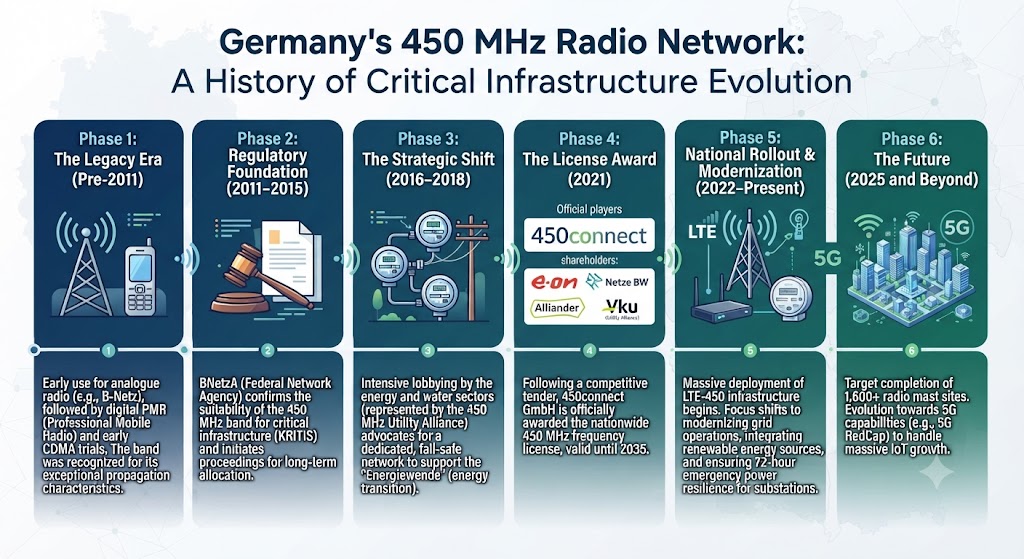
- Phase 1: The Legacy Era (Pre-2011): Early use for analog radio (B-Netz) and initial digital Professional Mobile Radio (PMR). The band’s superior propagation characteristics were recognized early on.
- Phase 2: Regulatory Foundation (2011–2015): The Federal Network Agency (BNetzA) identifies the 450 MHz band as uniquely suitable for critical infrastructure due to its range and penetration.
- Phase 3: The Strategic Shift (2016–2018): Intense advocacy from the energy and water sectors (led by the 450 MHz Utility Alliance) pushes for a dedicated, fail-safe network to support the digital demands of the Energiewende.
- Phase 4: The License Award (2021): Following a competitive tender, the nationwide license is awarded to 450connect GmbH, a consortium backed by major utility players (E.ON, Netze BW, Alliander, and the Utility Alliance VKU).
- Phase 5: National Rollout & Modernization (2022–Present): Massive deployment of LTE-450 infrastructure begins. Focus shifts to modernizing grid operations, integrating renewables, and deploying 72-hour emergency power solutions.
- Phase 6: The Future (2025 and Beyond): Target completion of 1,600+ radio mast sites. Evolution towards advanced capabilities like 5G RedCap to handle massive IoT growth.]
Why 450 MHz is the “Gold Standard” for Utilities
Unlike commercial mobile networks (Telekom, Vodafone, O2), which prioritize high data throughput in densely populated areas, the 450 MHz network is optimized for coverage, penetration, and reliability. For a utility operator managing thousands of widely dispersed assets, this low-frequency band is superior for several key reasons:
- Exceptional Propagation: The low frequency allows signals to travel long distances and penetrate deep into buildings, basements, and challenging topographical areas. This is essential for reaching remote smart meters and infrastructure that is often shielded.
- Superior Coverage with Less Infrastructure: Because the signal travels so far, a relatively small number of radio masts can cover the entire country. This “wide-area” coverage is more efficient and reliable than trying to densify a high-frequency network for the same purpose.
- Guaranteed Resilience and Redundancy: The network is built to “KRITIS” standards. Crucially, this mandates a minimum of 72-hour emergency power backup at every base station, ensuring that critical control signals—such as those for switching substations or reading smart meters during a blackout—do not fail when they are needed most.
Key Players and the Role of 450connect
The execution of this critical national project is spearheaded by 450connect GmbH. Their success is rooted in their ownership structure, which unites the very industries the network is designed to serve:
- Shareholders: 450connect is backed by a powerful consortium including E.ON, Netze BW (a subsidiary of EnBW), Alliander, and the 450 MHz Utility Alliance (representing numerous municipal utilities).
- Mission: Their mandate is to build and operate a secure, interference-free radio platform (using 3GPP bands B31 and B72) that supports the digitalization of the energy and water transition, as well as the needs of public safety and emergency services.
The 450connect network provides a sovereign communication channel, meaning utilities are not reliant on the commercial priorities of public mobile operators.
Technology Update: The Shift to LTE-450
The German network is being built on the LTE-450 standard. While previous generations of 450 MHz technology utilized CDMA, LTE-450 is the clear choice for modern critical infrastructure for several technical and strategic advantages:
- Enhanced Data Rates: While not as fast as 5G, LTE-450 offers sufficient bandwidth for real-time grid monitoring, remote control of decentralized generation (PV and wind), and the secure transmission of smart meter data.
- Future-Proofing and the IoT: LTE-450 efficiently manages the massive influx of IoT (Internet of Things) devices connecting to the energy grid. It also provides a clear migration path towards future 5G technologies tailored for industrial IoT, such as 5G RedCap (Reduced Capability).
- Mature Ecosystem: There is a rapidly growing market of industrial-grade end devices—including routers, gateways, and M.2 modules—that are certified for critical infrastructure use. Many of these devices are also incorporating security features like ISO 27001 certification, ensuring end-to-end network integrity.
The Path Forward
Germany is currently in the peak deployment phase, with a target of having over 1,600 radio mast sites operational by 2025. For the nation’s energy and water suppliers, the transition is no longer a question of “if,” but “how fast.” The 450 MHz network is the foundational layer that will keep the lights on and the water flowing as Germany marches toward a decentralized and carbon-neutral future.
For ongoing updates on the German 450 MHz rollout, industrial IoT solutions, and the broader European critical infrastructure landscape, stay tuned to lte450.co.uk.