
Strengthening the Edge: The Critical Convergence of RF and Hardware
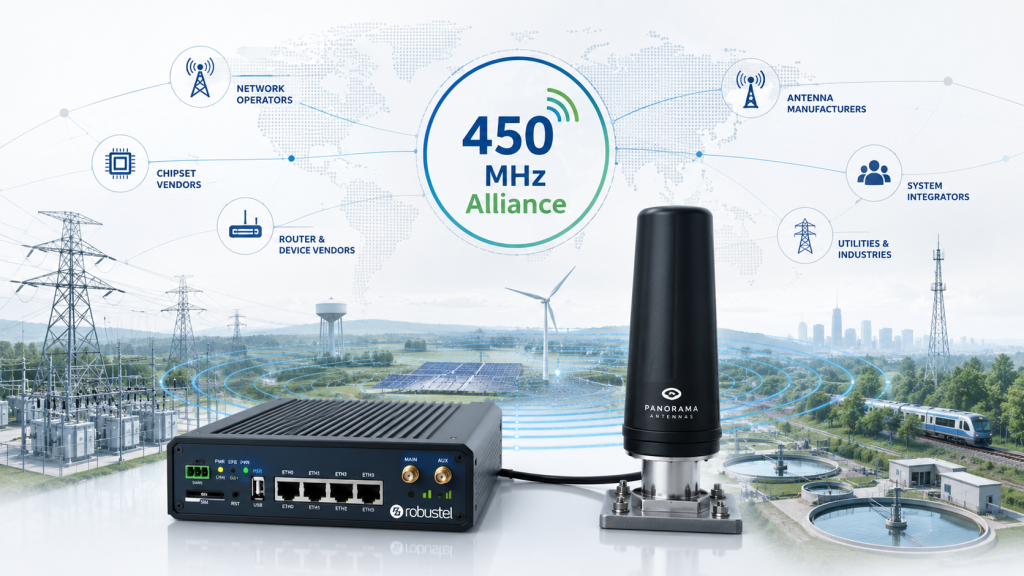
The LTE450 ecosystem continues to gather significant momentum with the formal addition of Panorama Antennas and Robustel as members of the 450 MHz Alliance. While membership announcements can often seem like routine corporate press releases, this development is highly significant. It directly strengthens two of the most critical, yet frequently overlooked, pillars of any mission-critical LTE450 deployment: highly specialized RF antenna engineering at the edge and rugged, industrially hardened cellular routing hardware.
For utilities, smart grid operators, system integrators, and critical national infrastructure (CNI) providers tracking the growth of sub-1 GHz private cellular networks, these additions represent a massive step forward. It signals that major industrial hardware suppliers are committing engineering resources to this specialized spectrum, paving the way for a more mature, competitive, and interoperable marketplace.
1. What is the 450 MHz Alliance?
The 450 MHz Alliance is a global industry association representing carriers, spectrum owners, equipment manufacturers, terminal vendors, and system integrators dedicated to driving the development and adoption of mobile networks in the 400 MHz and 450 MHz frequency bands.
Historically, these frequencies were the exclusive domain of legacy analogue PMR (Private Mobile Radio) systems, PAMR (Public Access Mobile Radio), and early-generation analogue cellular networks (such as NMT-450). As these older systems have been systematically decommissioned worldwide, the 450 MHz Alliance has successfully lobbied regulators to reallocate this premium spectrum for modern 3GPP standards, specifically:
- LTE Band 31: Uplink: 452.5 MHz – 457.5 MHz | Downlink: 462.5 MHz – 467.5 MHz
- LTE Band 72: Uplink: 451.0 MHz – 456.0 MHz | Downlink: 461.0 MHz – 466.0 MHz
- LTE Band 87: Uplink: 410.0 MHz – 415.0 MHz | Downlink: 420.0 MHz – 425.0 MHz
- LTE Band 88: Uplink: 412.0 MHz – 417.0 MHz | Downlink: 422.0 MHz – 427.0 MHz
The Alliance acts as a central hub for coordinating standardisation, promoting regulatory harmonisation, publishing technical white papers, managing device certification initiatives, and hosting global conferences. By aligning operators (such as 450Connect in Germany, Net 1 in Scandinavia, and Utility Communications in the UK) with major hardware vendors, the Alliance ensures that when a utility decides to build a private LTE450 network, a robust, standardized ecosystem of compatible silicon, modules, routers, and antennas is ready to support them.
2. Why LTE450 Needs a Specialized Hardware Ecosystem
Building a wide-area network at 450 MHz is fundamentally different from building a commercial cellular network at 1.8 GHz, 2.1 GHz, or 3.5 GHz. While standard consumer mobile networks focus on massive bandwidth and high-density, short-range cell sites, LTE450 is optimized for broad geographical coverage, deep building penetration, and high operational resilience.
However, specialized spectrum only succeeds when a mature ecosystem supports it. To understand why, consider the “chicken-and-egg” dilemma of private cellular bands:
- Operators and Utilities cannot commit hundreds of millions of pounds to roll out network infrastructure unless they are certain that a wide variety of compliant devices exist.
- Silicon and Device Manufacturers are reluctant to spend engineering hours and capital certifying hardware for a specialized radio band unless they see a guaranteed, high-volume pipeline of operator deployments.
By bringing legacy industrial IoT heavyweights into the fold, the 450 MHz Alliance breaks this cycle. The entry of Panorama Antennas (providing the physical RF interface) and Robustel (providing the secure, intelligent edge platform) shows that the ecosystem has moved past its infancy. It is now a highly viable commercial market capable of sustaining competitive, long-term CNI projects.
3. Panorama Antennas: Overcoming the 450 MHz RF Challenge
Panorama Antennas is a highly respected pioneer in antenna technology, with nearly eight decades of experience designing high-performance RF components. Their addition to the Alliance is critical because antenna design at 450 MHz is a highly specialized science.
In wireless communications, the physical size of an antenna element is directly proportional to the wavelength (λ) of the frequency it is designed to receive, calculated using the standard wave equation:
λ = v / f
Where v is the speed of light (3 × 10^8 m/s) and f is the target frequency.
- At a standard commercial LTE frequency of 2.1 GHz (2100 MHz), the wavelength is roughly 14.2 cm. A standard quarter-wave monopole antenna is only 3.5 cm long, making it incredibly easy to fit inside small plastic enclosures, smart meters, or sleek vehicular pucks.
- At 450 MHz, the wavelength increases dramatically to 66.6 cm. A quarter-wave antenna must be approximately 16.6 cm long.
If an inexperienced engineer simply tries to scale up a standard antenna, the resulting product is often too large, visually intrusive, or physically vulnerable to fit inside utility kiosks, smart meters, or compact vehicle mounts. Improperly designed antennas lead to extreme impedance mismatches, high Voltage Standing Wave Ratios (VSWR), and ultimately, wasted power and dropped packets.
Panorama’s Engineering Approach to 450 MHz
Panorama Antennas addresses these constraints through advanced internal impedance matching, helical loading, and multi-band integration. Their specialized 450 MHz portfolio focuses on key areas:
- Low-profile transit antennas: Combining LTE450/410 elements alongside multi-band 2G/3G/4G/5G, Wi-Fi, and GPS/GNSS elements in a single, vandal-resistant, heavy-duty housing.
- Smart meter antennas: Purpose-built to sit inside metallic or concrete cabinets, utilizing highly specialized ground-plane independent engineering to ensure signals escape harsh physical enclosures.
- High-gain directional yagi and omnidirectional base station antennas: Designed to survive extreme weather conditions, including high wind speeds and corrosive marine environments common to wind farms and coastal utilities.
Without high-performance antennas, the physical propagation advantages of 450 MHz are lost. Panorama’s participation ensures that system integrators have off-the-shelf access to highly efficient, rugged, and fully certified RF solutions.
4. Robustel: Hardened Edge Intelligence for LTE450 Networks
While the antenna is responsible for capturing the signal, the industrial router serves as the logical brain of the edge site. Robustel is a globally recognized manufacturer of industrial cellular routers, gateways, and IoT edge devices designed to thrive in harsh physical and electrical environments.
Robustel’s entry into the 450 MHz Alliance is a major win for CNI operators because their routers are purpose-built for the rugged, high-security requirements of industrial automation.
Key Features of Robustel LTE450-Capable Gateways:
- Industrial Protocols & Legacy Bridging: Many electricity substations, water pumping stations, and gas valves still communicate using legacy serial protocols such as Modbus RTU, DNP3, or IEC 60870-5-101. Robustel routers feature RS-232 and RS-485 interfaces paired with software stacks that can encapsulate these legacy protocols into IP-based traffic (such as IEC 104) over the LTE450 network.
- Hardware Hardening: Standard commercial routers fail when exposed to extreme temperatures. Robustel devices are housed in robust, metal enclosures IP30-rated (or higher) and designed to operate reliably in extreme temperatures ranging from -40°C to +75°C.
- Dual-SIM and eSIM Failover: For mission-critical infrastructure, uptime is non-negotiable. Robustel’s dual-SIM architecture allows an edge router to use a private LTE450 network as its primary connection, with seamless failover to a public commercial 4G/5G network (or vice versa) if a network event occurs.
- Advanced VPN Tunneling & Cybersecurity: Industrial operators require end-to-end encryption. Robustel’s Linux-based operating system, RobustOS, supports highly secure VPN protocols including IPsec, OpenVPN, WireGuard, and GRE, alongside integrated firewalls and robust stateful packet inspection.
5. Why the RF and Hardware Integration is Critical for Utilities
A major hurdle for any CNI deployment is avoiding vendor lock-in and minimizing system integration risks. Historically, some private LTE450 deployments required piecing together custom-engineered solutions: buying a router from one vendor, sourcing a niche RF filter from another, adapting an antenna from a third, and spending months debugging signal attenuation and mismatch losses.
The combined membership of Panorama and Robustel changes this. It allows engineers to design complete, tested, and optimized end-to-end communication nodes.
When these components are built by manufacturers who actively collaborate within the same Alliance, the risk of RF interference, impedance mismatch, or firmware incompatibility is drastically reduced. This direct interoperability speeds up field rollouts, reduces engineering costs, and ensures that the low power consumption requirements of remote RTUs are met perfectly.
| Deployment Component | Role in LTE450 Node | Key Technical Requirements |
| Panorama Antenna | Translates electromagnetic waves from the air into RF signals. | High gain, compact footprint, resistance to water ingress, low voltage standing wave ratio (VSWR). |
| Low-Loss Coaxial Cable | Transports RF signals between antenna and router with minimal attenuation. | Thick, high-quality copper shielding, impedance-matched SMA connectors. |
| Robustel Edge Router | Demodulates LTE signals, processes IP data, and handles edge security. | Rugged housing, low power consumption, protocol conversion, dual-SIM redundancy. |
| Field Asset (RTU / PLC) | Collects physical telemetry (voltage, flow rate, pressure). | RS-485, Modbus, or Ethernet connection. |
6. Deep Dive: Key LTE450 Use Cases Across CNI
To understand why the growing LTE450 ecosystem is so important, we must examine the specific high-consequence industries that rely on this spectrum.
Smart Grid & Distribution Automation (DSOs)
For Distribution System Operators (DSOs), the electricity grid is changing rapidly. The rise of distributed renewable energy generation (wind, solar) and electric vehicle (EV) charging stations has transformed the grid from a simple, predictable, one-way system into a highly volatile, multi-directional network. To keep this grid stable, DSOs need real-time visibility and control over thousands of secondary substations, reclosers, ring main units (RMUs), and smart meters.
- The Challenge: These assets are often located in deep basements, dense urban concrete structures, or highly remote rural fields where public cellular signals cannot reach.
- The LTE450 Solution: The superb building penetration and wide coverage area of 450 MHz allow DSOs to establish secure, low-latency, private IP links directly to these remote locations, enabling automated grid balancing, fault isolation, and remote telemetry.
Water and Gas Utilities
Water and gas networks are characterized by vast, sprawling geographical footprints with millions of remote, battery-powered monitoring points (flow meters, pressure sensors, leak detectors).
- The Challenge: Many monitoring sites do not have access to mains power. Changing batteries on thousands of remote sensors is extremely expensive, meaning devices must operate for 10 to 15 years on a single battery.
- The LTE450 Solution: When combined with narrowband technologies (like LTE-M or NB-IoT) deployed on Band 31 or Band 72, LTE450 offers an exceptionally efficient link budget, allowing devices to transmit data from deep underground chambers without rapidly draining their batteries.
Railways and Transport Infrastructure
Modern rail systems require highly reliable voice and data links for signalling, trackside monitoring, passenger safety, and automated train control. As legacy GSM-R networks are phased out in the coming years, rail operators are looking to Future Railway Mobile Communication System (FRMCS) and private LTE/5G networks.
- The Challenge: Laying thousands of miles of fibre optic cables along remote train tracks is cost-prohibitive, and public cellular networks do not cover long rural rail segments reliably.
- The LTE450 Solution: A private LTE450 network can cover hundreds of miles of railway with a fraction of the base stations required by higher-frequency systems, providing dedicated, low-latency communication lines for train drivers and autonomous track monitors.
7. Technical Comparison: LTE450 vs. Alternative Technologies
When planning critical communications, utilities and CNI operators frequently compare LTE450 to other technologies. The table below illustrates why LTE450 is often the preferred choice for wide-area, mission-critical infrastructure:
| Feature / Metric | LTE450 (Band 31 / 72) | Public 4G / 5G | LoRaWAN (Unlicensed) | Private 5G (Mid/High Band) |
| Typical Range | Very High (30 – 100 km) | Medium (5 – 15 km) | High (10 – 20 km) | Low (1 – 3 km) |
| Building Penetration | Excellent (Sub-1 GHz) | Moderate (1.8 GHz+) | Excellent (868 MHz) | Poor (High frequency) |
| Spectrum Ownership | Licensed/Private | Shared/Public Carriers | Unlicensed Shared Band | Licensed Local Private |
| Throughput Data Rate | Moderate (1 – 15 Mbps) | High (10 – 500 Mbps) | Very Low (0.3 – 50 kbps) | Extremely High (100+ Mbps) |
| SLA & Resilience | Absolute Control | Best Effort | Moderate (Best Effort) | Absolute Control |
| Hardware Lifetime | 15 – 20 Years | 2 – 5 Years | 10 – 15 Years | 10 – 15 Years |
Why Unlicensed LPWAN (LoRaWAN) Falls Short for SCADA
While LoRaWAN is excellent for highly distributed, low-consequence sensors (like agricultural soil moisture monitoring), it operates in unlicensed spectrum (868 MHz in Europe). This means any consumer device, smart home hub, or nearby factory can transmit on the same frequencies, causing unpredictable packet collisions and latency spikes. For critical SCADA operations—where a DSO must open a high-voltage circuit breaker within milliseconds to protect assets and human lives—unlicensed, “best-effort” networks are a structural non-starter.
Why Public Cellular Networks Cannot Guarantee CNI SLAs
Public mobile networks are optimized for consumer smartphones. During a major storm, flood, or power grid failure, public cell towers quickly become overloaded with thousands of citizens trying to call loved ones or stream emergency news. Furthermore, public network operators do not guarantee backup battery power at their cell sites for more than a few hours.
An LTE450 network owned or leased exclusively by a utility, however, is built with 24 to 72 hours of battery backup (or diesel generators) at every eNodeB site, ensuring that the communications infrastructure remains fully operational even during a prolonged blackout.
8. Why 450 MHz Propagation is Uniquely Suited to Critical Infrastructure
The core justification for deploying an LTE450 network always comes down to the laws of physics. Lower-frequency signals travel significantly further and wrap around obstacles far more effectively than high-frequency signals due to the properties of RF diffraction.
Because a single 450 MHz base station can reliably cover a radius of 30 to 100 km depending on topography, an operator can blanket an entire country with a fraction of the physical infrastructure required by standard networks. This drastically lowers capital expenditure (CapEx) and operating expenses (OpEx), while ensuring that even the most remote rural assets remain firmly within network reach.
9. The Future of LTE450: 3GPP Release 17, RedCap, and 5G Evolution
As the telecommunications industry transitions from 4G LTE to 5G, the 450 MHz ecosystem is evolving in parallel. The 3GPP standards body has fully integrated 450 MHz support into 5G NR (New Radio) specifications, ensuring the spectral longevity of these bands.
The Critical Role of 5G RedCap (Reduced Capability)
One of the most exciting developments for the 450 MHz band is 5G RedCap (standardized in 3GPP Release 17). RedCap is a purpose-built device category designed to bridge the gap between high-speed 5G broadband and low-speed, ultra-narrowband IoT (NB-IoT/LTE-M).
- RedCap provides optimal mid-tier throughput (up to 150 Mbps downlink and 50 Mbps uplink) with drastically reduced device complexity and significantly lower power consumption profiles.
- For industrial edge devices (such as Robustel routers) paired with high-efficiency antennas (such as Panorama’s portfolio), RedCap acts as an ideal catalyst. It allows industrial endpoints to handle complex telemetry, network slicing, and security parameters natively over 5G without the high components costs and thermal profiles of traditional Release 15/16 high-speed 5G silicon.
10. Conclusion: Why This Announcement is a Turning Point
The addition of Panorama Antennas and Robustel to the 450 MHz Alliance is a structural turning point for the utility and industrial communications sector. It sends a definitive signal to the market that the 450 MHz ecosystem has achieved structural maturity. Operators, integrators, and utilities now have direct, off-the-shelf access to an interoperable, highly resilient suite of components capable of supporting mission-critical operations over decades-long lifecycles.
Related LTE450 Topics: Architectural Quick-Reference Hub
If you are currently deploying, auditing, or researching sub-1 GHz cellular infrastructure, use this on-page reference centre to answer key technical questions immediately without leaving the page.
What is LTE450 and why does 450 MHz matter?
- The Core Concept: LTE450 refers to standard 4G LTE and 5G New Radio (NR) protocols operating in the licensed spectrum between 410 MHz and 470 MHz.
- Why it Matters: High-frequency bands (like 1.8 GHz, 2.6 GHz, and 3.5 GHz) require a high density of base stations to maintain coverage. The physical properties of the 450 MHz wave allow a single cell tower to cover massive geographic areas.
Quick Physics Breakdown
- Frequency: 450 MHz (Longer wavelength, roughly 66 cm)
- Propagation Behavior: Low path loss, excellent signal diffraction around geographical obstacles, and deep structural penetration.
- Target Audience: Critical National Infrastructure (CNI), utility grids, municipal water networks, and smart metering deployments.
The complete history of LTE450 worldwide
- Legacy Roots: Originally, the 450 MHz band was utilized for first-generation analogue mobile networks (like NMT-450 in the Nordic countries) and legacy PMR/PAMR systems.
- The Modern Transition: As analogue networks decommissioned, the 450 MHz Alliance lobbied standardisation bodies (3GPP) to define dedicated LTE bands. This resulted in the creation of Band 31 and Band 72, creating a globally standardized ecosystem that moved the band from niche analogue PMR to modern, high-security IP-based cellular.
LTE450 vs. Private 5G (Mid/High Band)
A common architectural dilemma is choosing between a private 450 MHz network and a localized private 5G network (typically operating on 3.5 GHz / CBRS bands). Use this rapid-decision matrix:
| Metric / Requirement | Choose LTE450 | Choose Private 5G (3.5 GHz+) |
| Geographic Footprint | Regional, nationwide, or sprawling rural footprints. | Highly localized (single factory, port, campus, or mine). |
| Asset Density | Highly distributed, low-density telemetry points. | Extremely high density of high-bandwidth sensors. |
| Primary Use Case | SCADA, smart meters, line-switch monitors. | HD video analytics, autonomous robotics, low-latency control. |
| Typical Base Station Range | Up to 100 km (Line of Sight). | 1 km to 3 km. |
LTE450 vs. LoRaWAN
- The Key Difference: LoRaWAN operates on unlicensed spectrum (868 MHz in Europe / 915 MHz in North America). LTE450 operates exclusively on licensed, dedicated spectrum.
- Reliability: Because LoRaWAN shares spectrum with millions of consumer IoT devices, it is prone to packet collisions and interference. LTE450 provides guaranteed, deterministic Quality of Service (QoS) and low latency required for utility control.
- Security: LTE450 utilizes SIM/eSIM hardware-based authentication and 3GPP security standards, whereas LoRaWAN relies entirely on software-key encryption.
LTE450 vs. NB-IoT & LTE-M (On-Grid Comparison)
Many engineers ask if they should use standard cellular LPWAN (NB-IoT/LTE-M) or dedicated LTE450. The answer is often both, as NB-IoT and LTE-M are frequently deployed inside the LTE450 bands (Band 31/72).
- LTE-M over 450 MHz: Best for assets requiring low-to-moderate latency, voice support, and mobile tracking (e.g., smart grid reclosers, utility vehicles).
- NB-IoT over 450 MHz: Best for extreme building penetration and maximum battery life (up to 15 years), making it ideal for underground water meters, gas monitors, and deep-indoor sensors.
Why utilities choose 450 MHz instead of public cellular
Public cellular carriers (Vodafone, EE, O2, etc.) cannot guarantee the strict service levels required by critical utility infrastructure during a national crisis.
The CNI Resilience Checklist
- [ ] Blackout Autonomy: Private LTE450 base stations are engineered with 24 to 72 hours of onsite battery or generator backup. Public towers typically fail within 2 to 4 hours of a power loss.
- [ ] Congestion Isolation: During emergencies, public networks become severely congested with consumer traffic. Private LTE450 isolates utility traffic completely.
- [ ] Lifecycle Control: Commercial carriers phase out network generations (like 3G shutdowns) on consumer timelines (typically 5–10 years). Utilities require 15–20 year lifecycles, which they control entirely with a private network.
How far does LTE450 really reach?
In real-world field trials and deployments, the range of an LTE450 cell site is highly dependent on terrain, tower height, and antenna gain:
- Flat/Rural Terrain: 50 km to 100 km per base station.
- Suburban/Rolling Hills: 20 km to 40 km per base station.
- Dense Urban Environments: 5 km to 15 km, with unmatched deep-indoor and basement penetration compared to commercial cellular frequencies.
LTE450 Antenna Selection Guide
Deploying 450 MHz equipment requires highly targeted antenna selection to compensate for the larger wavelength (~66 cm):
- Directional Yagi Antennas: Best for stationary, highly remote sites (like water pumping stations or rural substations) where pointing directly at a distant cell tower maximizes signal gain.
- Omnidirectional Whip Antennas: Ideal for vehicle fleets or suburban smart meters where the exact direction of the closest base station may vary or change during network routing.
- Low-Profile Puck Antennas: Used on transit vehicles or street-level kiosks where vandal resistance and low visual impact are required.
Understanding propagation at 450 MHz
- The Physics: Electromagnetic waves at lower frequencies diffract (bend) more easily around large physical obstacles like hills, buildings, and heavy vegetation.
- Ground Penetration: Lower-frequency signals suffer significantly less attenuation when traveling through earth, wet concrete, and asphalt, which is why LTE450 excels at reaching underground water valves and basement electricity meters.
LTE450 Routers, Gateways, and Modems Explained
An LTE450 communications node is typically categorized by its processing power and edge capabilities:
- LTE450 Modems: Simple, low-power cellular modules embedded directly into a smart meter or sensor. They handle the basic RF connection and pass raw data to an internal microcontroller.
- LTE450 Gateways: Compact edge devices that convert specific legacy protocols (like Modbus RTU) to IP-based traffic, designed to connect single field assets.
- LTE450 Routers: Highly robust, multi-port routing engines (like Robustel’s hardware) capable of managing VPNs, active firewalls, local scripting, and multiple physical connections (Ethernet, Serial, Wi-Fi) simultaneously.
LTE450 RTUs for SCADA
Remote Terminal Units (RTUs) are the physical interfaces that monitor and control utility grid hardware (switches, breakers, pumps).
- Legacy vs. Modern: Traditional SCADA networks relied on low-speed radio or dial-up links. Modernizing with LTE450 allows RTUs to communicate using secure, high-speed IP protocols like IEC 60870-5-104 and DNP3 over IP, enabling real-time micro-grid balancing and instant fault detection.
Industrial computers for LTE450
For edge-heavy environments, standard routers are replaced by industrial computers containing embedded LTE450 modules. This setup allows for:
- Edge Computing: Running containerized applications (like Docker) directly at the substation.
- Local Data Analytics: Filtering out noise and analyzing high-frequency grid waveforms locally, transmitting only anomalies over the cellular link to save network bandwidth.
SIM cards for LTE450 networks
To secure a private cellular network, standard consumer SIM cards cannot be used. Instead, operators utilize:
- Industrial M2M SIMs: Engineered to withstand extreme vibrations and temperature ranges (-40°C to +105°C).
- eSIM / eUICC Technology: Allows utilities to deploy thousands of smart meters with a single physical SIM chip soldered to the circuit board, with the ability to securely swap cellular operators or profiles over-the-air (OTA) in the future.
VPNs for LTE450 SCADA
Security is paramount when connecting critical national infrastructure. All LTE450 traffic should be encrypted using enterprise-grade Virtual Private Networks (VPNs):
- IPsec: The industry standard for site-to-site tunnels between edge routers and the central utility control room.
- OpenVPN & WireGuard: Increasingly popular alternatives for edge-to-cloud routing due to their lighter software footprints and faster reconnection times in low-signal environments.
Public vs. Private LTE450 Networks
Utilities have two distinct deployment models when adopting 450 MHz technology:
- The Private Model: The utility purchases the spectrum, builds the base stations, and manages the core network. This offers absolute control, zero monthly carrier fees, and maximum security, but requires high initial capital expenditure (CapEx).
- The Public/Sourced Model: The utility partners with a dedicated CNI carrier (like 450Connect in Germany) who builds the network and leases secure “slices” of the spectrum to the utility. This reduces CapEx and deployment times while still providing strict SLA guarantees.
The Future of LTE450 and 5G RedCap
As we transition fully into the 5G era, 450 MHz bands will not become obsolete. Instead, standard 5G New Radio (NR) protocols are being designed to run directly on sub-1 GHz bands.
The introduction of 5G RedCap (Reduced Capability) is the primary driver for this evolution, allowing cheap, low-power 5G modules to operate over 450 MHz spectrum—enabling utilities to deploy long-lifecycle 5G endpoints at smart grid scale.